Inevitable and unstoppable, hurricanes, windstorms and tornadoes can devastate Southern U.S. forests. But these trees are also prey to another danger, bark beetles, that can become deadly infestations.
Forest debris created by storms can invite beetles and pests into tree stands and cause even more damage. In hopes of mitigating the economic loss due to damaged tree stands, UGA researcher Kamal Gandhi, Ph.D., is conducting research on the association between wind damaged forests and increased beetle populations. In October 2019, Gandhi published preliminary research through the University of Georgia’s Warnell School of Forestry and Natural Resources.
This research arose from questions about the vulnerability to beetles of trees that survive wind and storm damage. Gandhi says researchers wanted to find out if “these beetles increase in number and start attacking live trees,” when a population invades a damaged tree stand.
According to a study conducted in 2011 by the Department of Agriculture Forest Service, the Southern pine beetle causes more damage to forests in the Southern U.S. than any other insects and, in rare outbreaks, can cause economic losses of hundreds of millions of dollars. Preventing such outbreaks is at the heart of Gandhi’s research.
By collecting field samples of beetles in Southern forests damaged in 2018 by Hurricane Michael, Gandhi will measure the population size and growth of beetles as well as their chemical relations with the trees.
Gandhi says she expects to have analysis results in the next year and will then be able to publish her findings to help guide forest owners in the best ways to prevent further loss after damaging storms.
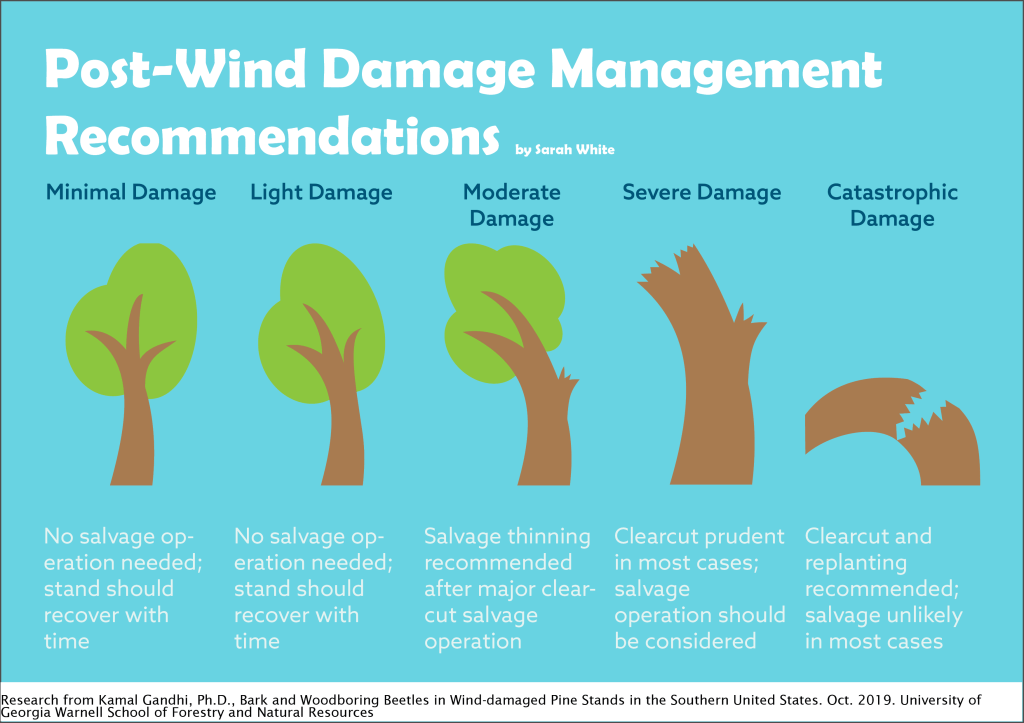
For now, recommendations to landowners on stand management post-wind-damage are based on the severity of damage. Gandhi says that if damage exceeds 50% of the tree population, managers should clear cut immediately to prevent further economic loss by growing a new population as soon as possible.
Research like Gandhi’s is becoming more crucial as climate change brings greater disturbances through an increased number and intensity of storms, according to a 1999 study of Atlantic and east coast hurricanes published in the Bulletin of the American Meteorological Society. Gandhi said she hopes further research will ask questions such as, “How can we manage our forests differently so that they are more resilient to these disturbances that are becoming more frequent over time?”
 Sarah White